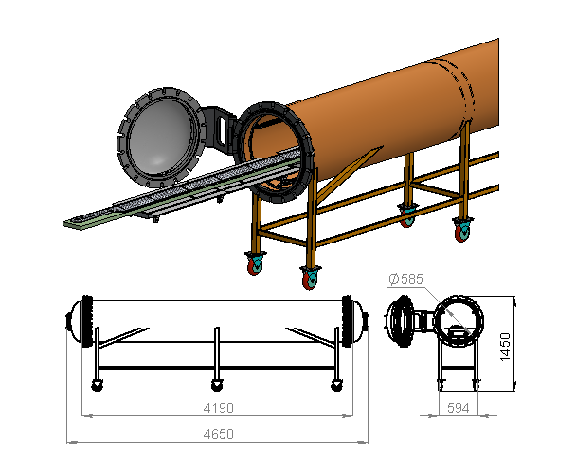
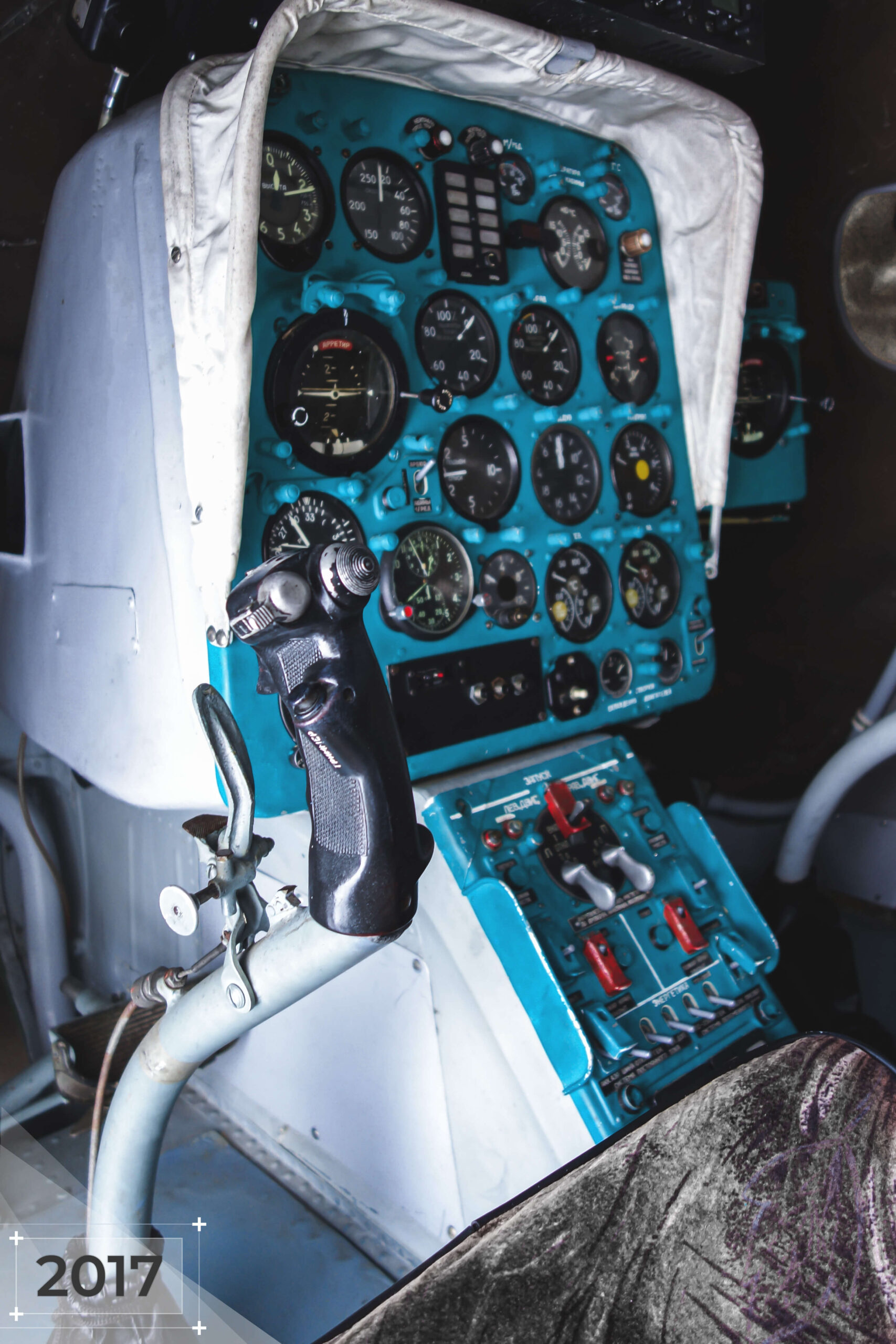
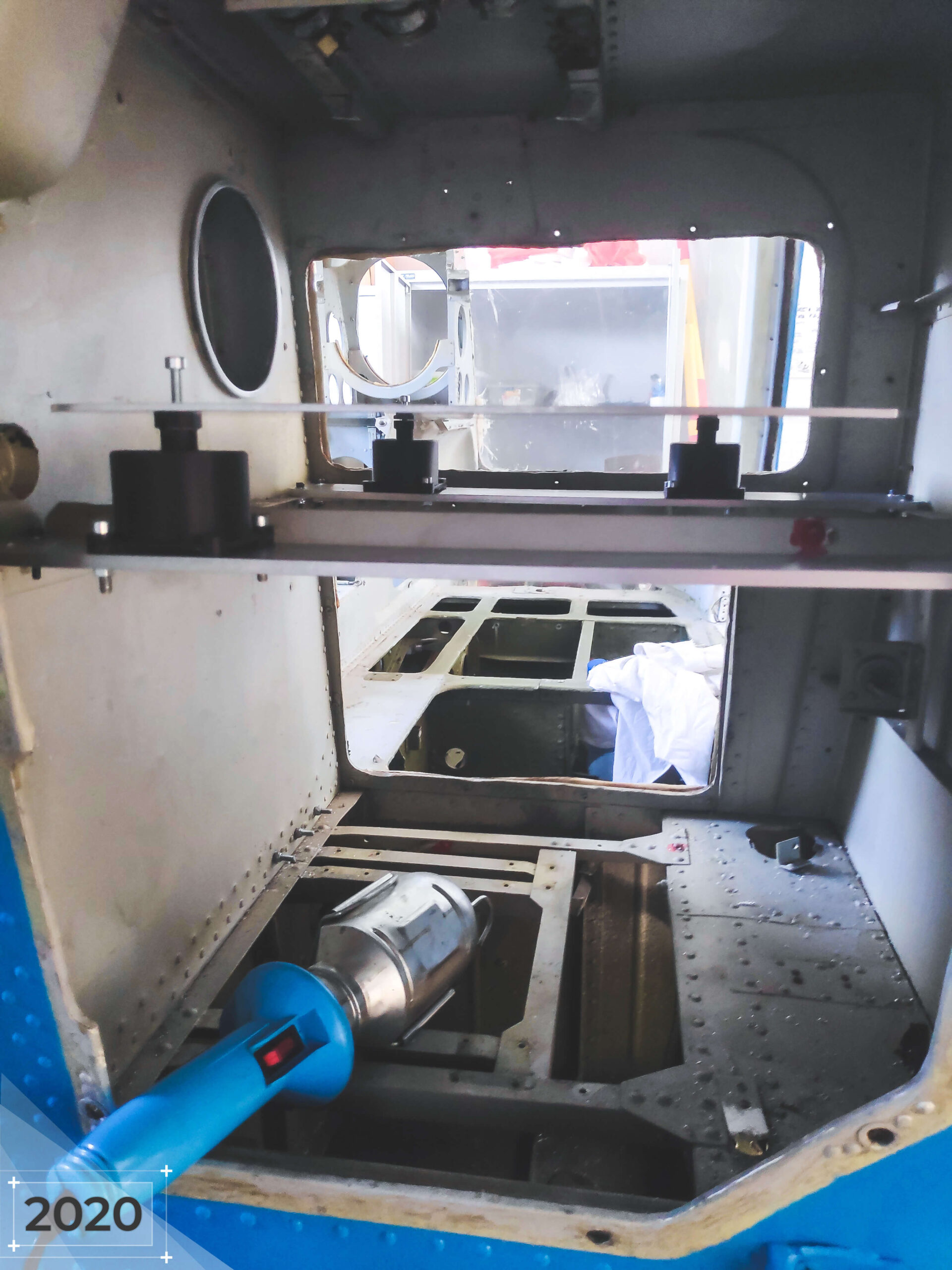
UVR LLC designed and manufactured an autoclave for the production of components from composite materials. This unit was developed as part of a program to create rotor blades for a helicopter-type UAV with a take-off weight up to 500 kg. The autoclave has been successfully tested. Its characteristics make it possible to make products from composite materials with overall dimensions up to 0.5 m in diameter and up to 4 meters in length, the generated overpressure is up to 6 atmospheres. The temperature inside the chamber can rise up to 120o C, with the possibility of adjusting according to a given program.
The operation of the autoclave is controlled by the authentic software, which, with the help of electric valves, temperature and pressure sensors, maintains a set technological process.
The use of the autoclave is planned both for the company’s own needs and as outsourcing for the manufacturers of products from composite materials that do not have such equipment.
July 22, 2022 | Sergey Litvinov
Successful Testing of a Prototype Radio Modem
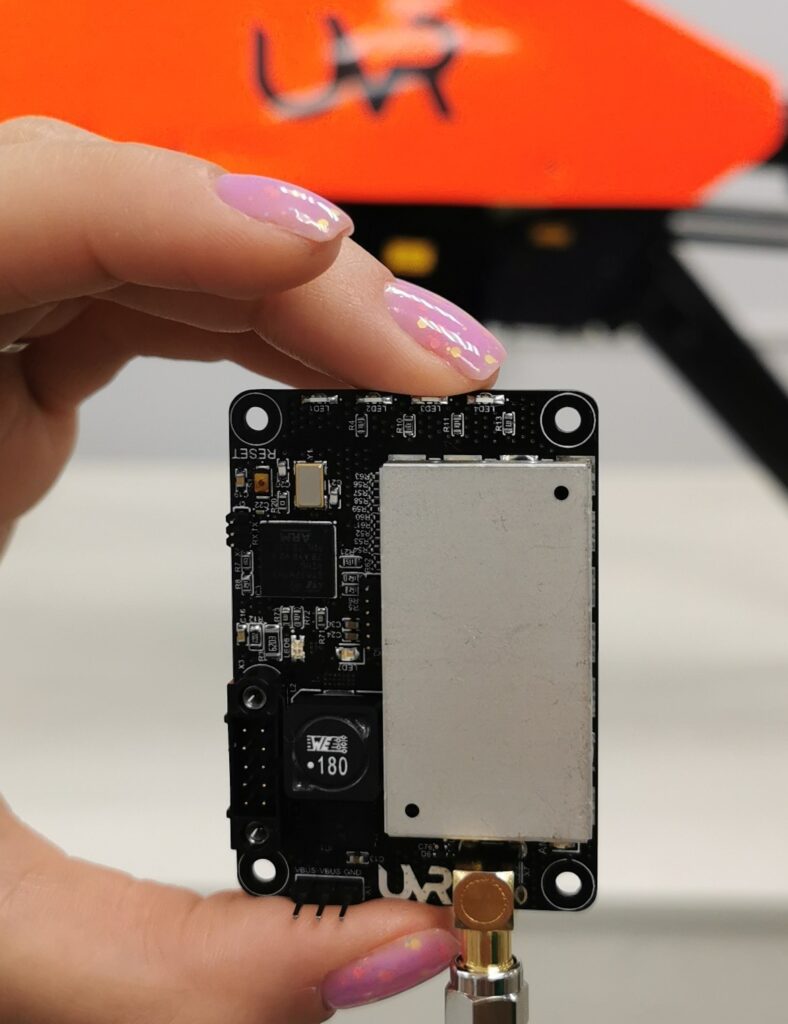
UVR LLC has developed a radio modem for UAVs control and transmitting telemetry, and successfully tested its prototype. The communication range of the device is 50 km in line-of-sight conditions at a data transfer rate of 57.6 kbps. Based on the prototype test results, two types of radio modem modules were developed:
– a radio modem module for the installation on a ground control station (GCS),
– a small-size radio modem module for the installation on a UAV.
Technical characteristics of the radio modem modules are the following:
– Frequency range of the modem: from 960 to 1020 MHz.
– Transmitter output power: up to 2W.
– Maximum data transfer rate: up to 300 kbps.
– Supply voltage range: from 5 to 105 V.
– Radio modem module interfaces for the GCS: Ethernet, Wi-Fi, USB, CAN (2 pcs.), UART.
– Interfaces of a small-size UAV radio modem module: CAN (2 pcs.), UART.
– Overall dimensions of the radio modem module board for GCS: 75 x 57 x 12 mm.
– Overall dimensions of the small-size UAV radio modem board: 57 x 40 x 12 mm.
qrf
June 16, 2022 | Sergey Litvinov
UVR Participation in the International Arctic Summit
UVR LLC took part in the 6th International Arctic Summit “The Arctic: Prospects, Innovations and Regional Development”, which took place on June 8-10, 2022 in Moscow and St. Petersburg.
The summit was attended by representatives of the administrations of several Northern regions of the Russian Federation, public and educational organizations, as well as the real sector of economy: resource-extracting, transport and other companies. More about the participants: Участники — АРКТИКА 2022 СПБ (arctic-summit.ru)
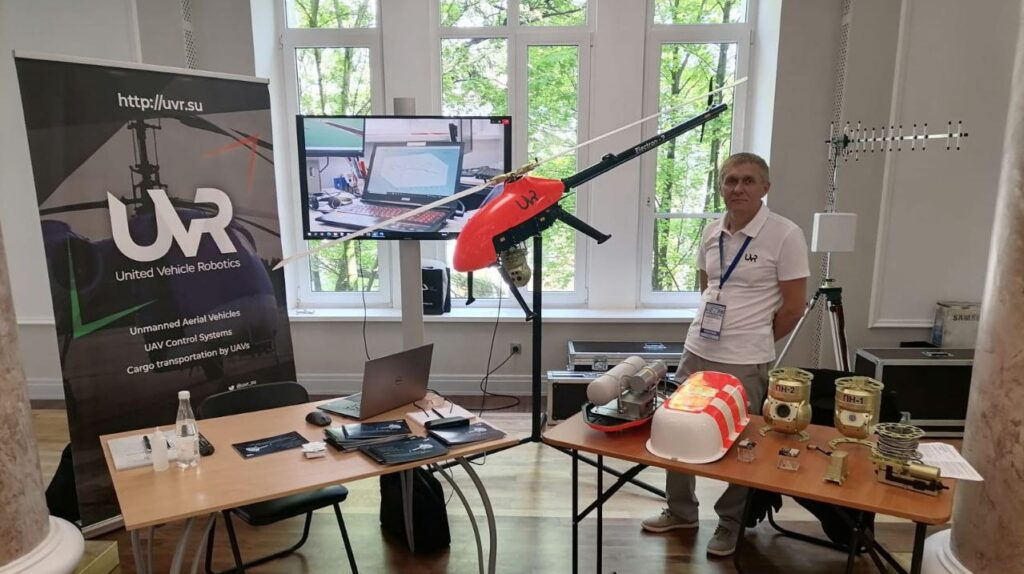
The booth of UVR was located in the 3rd building of St. Petersburg Electrotechnical University (“LETI”). The booth demonstrated UAV model “ELECTRON 7” with various payloads.
The model aroused interest among a wide range of forum visitors – from university students to heads of regions and organizations.
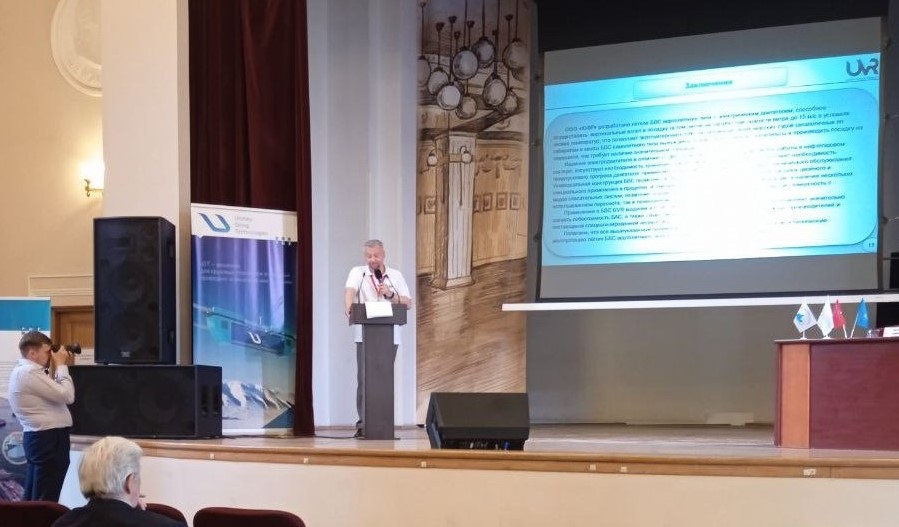
Various thematic sessions and round tables worked within the framework of the summit. During the session “Development of Science and Technology for the Development of the Arctic”, a representative of UVR LLC made a report on the topic “Perspectives and problematic issues in the development of helicopter-type UAVs used in the Arctic”. The information was greeted with interest by the audience.
The contacts and knowledge gained during the summit work will certainly be useful for the development of the company and the promotion of its products on the Russian market.
June 16, 2022 | Sergey Litvinov
ELECTRON 7 Successfully Demonstrated in the United Arab Emirates
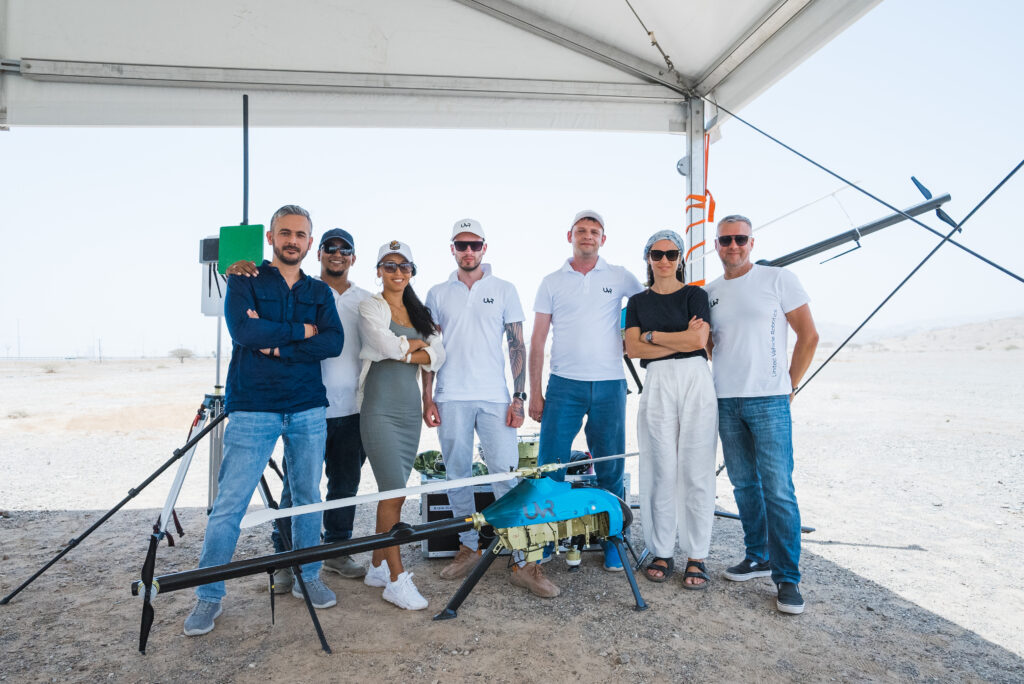
In early June the UVR team, with the assistance of uScovery DMCC and participation of ITOD Aircraft Manufacturing, successfully demonstrated the flights of the helicopter-type drone “ELECTRON 7” in the United Arab Emirates.
A sample of the unmanned aerial vehicle was presented to high-ranking officials and businessmen from the UAE in a remote area of the emirate Ras al-Khaimah in order to demonstrate the capabilities of the UAV in monitoring infrastructure, delivering of small cargo and security observing.
During the demonstration flights the drone completed tasks that included flying out of sight in a mountainous area, detailed inspection of a communication tower and monitoring road traffic. The high air temperatures, that caused certain inconvenience to those present at the show, did not affect the performance of the drone and confirmed its suitability for operation in the local hot climate.
January 27, 2022 | Mila Stepanova
Helicopter drone solves the problem of logistics in mountainous regions
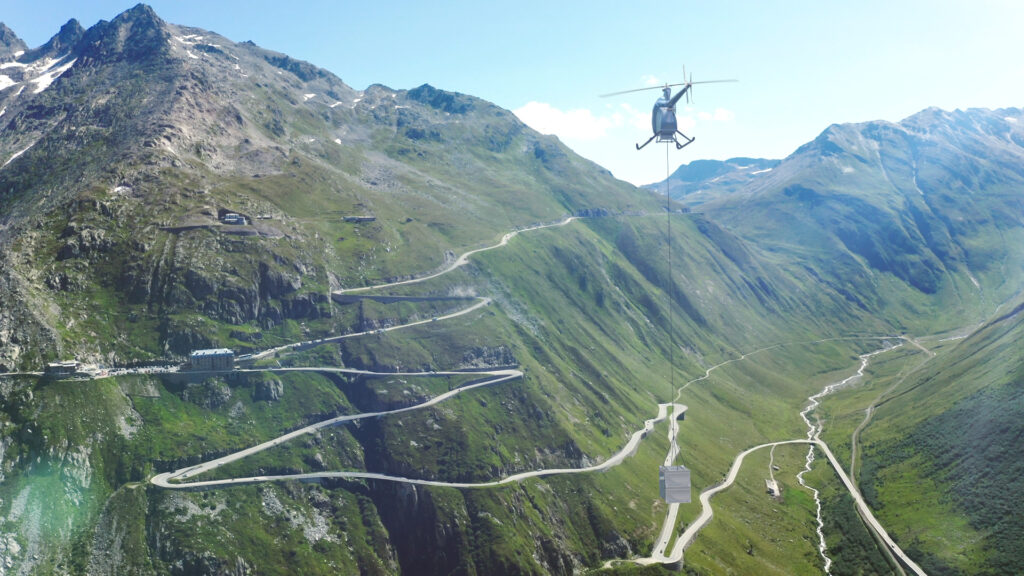
In freight logistics, there are tasks that are difficult to realize with traditional transport. For example, cargo delivery to settlements, resorts or construction sites located in the mountains. UVR creates a solution that would be effective for the logistics of hard-to-reach regions, both in terms of delivery speed, safety, and cost.
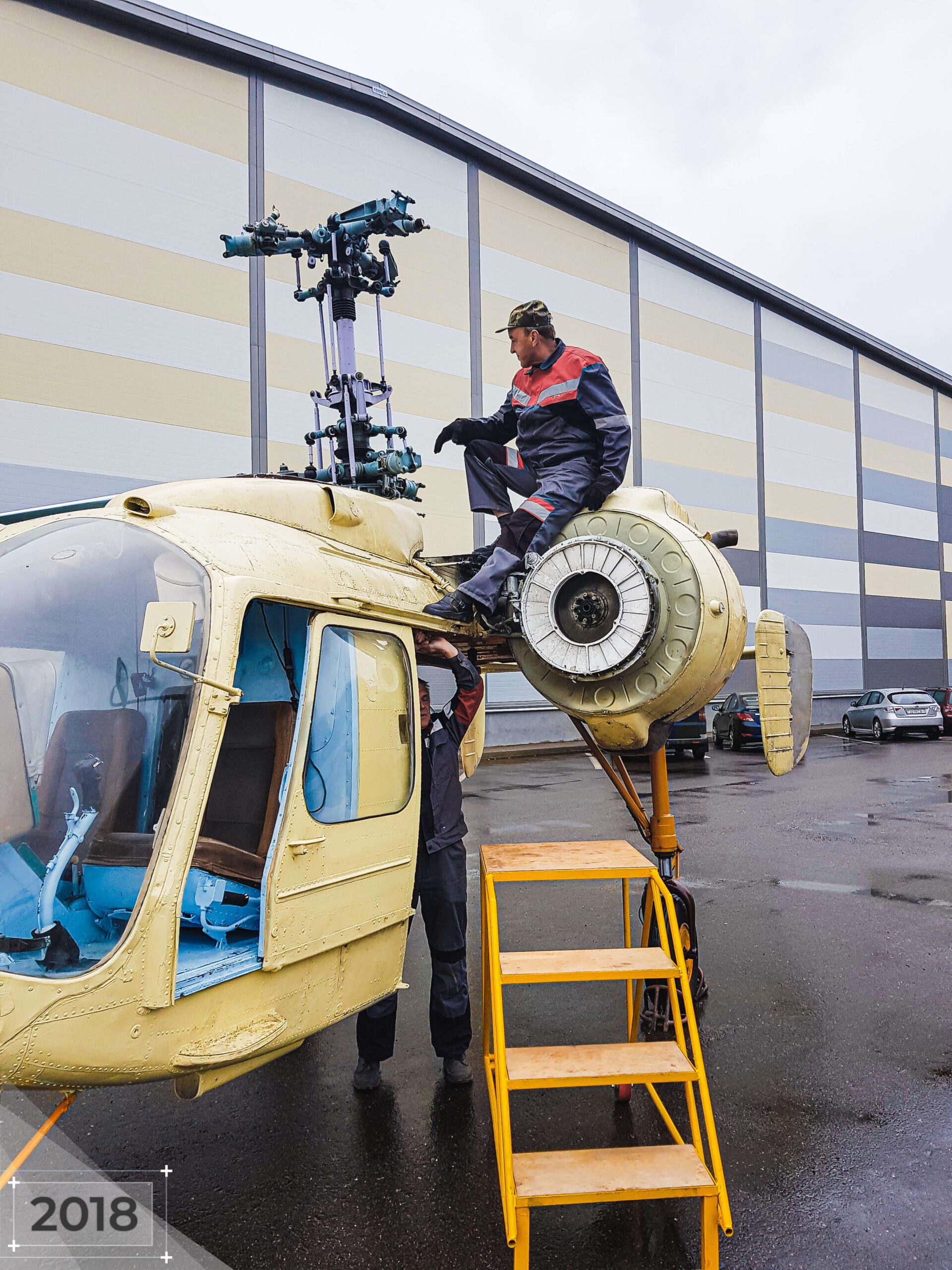
For this purpose, our specialists converted a manned helicopter Ch-7 and created a cargo drone Sakavik, which flies without a pilot in fully automatic mode.
Sakavik is unique in the segment of cargo drones due to its high performance:
a payload capacity of up to 180 kg (including fuel) allows it to deliver not only light parcels and postal items, but also essential goods and even repair equipment;
long range with cargo makes it possible to perform tasks over large areas, long linear objects, as well as in near-shore areas.
In this video, with as an example of Switzerland, we have shown that the drone’s characteristics allow it to logistically serve the entire country, delivering goods from large cities to small settlements and mountain resorts.
The safety of the Sakavik drone speaks for itself. Autopilot allows you to make the flight even if GPS signal is lost, to select a safe zone for landing, and to fly around obstacles. Human involvement is minimal: takeoff, en-route flight, and landing are fully automatic.
The Ch-7 Kompress was selected for conversion as an optimal model in terms of design, reliability, and cost. An important advantage was the helicopter’s ability to fly at altitudes of up to 5 km, which allows the drone to be used in mountainous terrain and perform tasks at high altitudes.
Our specialists dismantled the onboard equipment of the manned aircraft and developed components and assemblies for the drone. This was followed by assembly, long checks, fine-tuning and, of course, testing. The first successful drone flight took place on October 13, 2021. Currently the technical team improves the automatic control system. Despite the cold season and harsh weather conditions, that reduce the number of flying days, in February’22 we are planning to proceed with the test flights.
Sakavik is versatile not only in logistics, but also in other industries:
energy industry (inspection of pipelines, power lines, and other facilities);
precision agriculture and forestry (pest control, forest firefighting and other aerial operations);
security provision for large objects and territories.
The Sakavik unmanned aircraft system is already available for pre-orders.
March 31, 2021 | Mila Stepanova
UVR proved the ability to transport heavy cargo on an unmanned helicopter
Developers of aerial drones compete to be at the forefront of the freight segment. This doesn’t include parcel delivery and, instead, refers to heavy cargo of over 150 kg.
Assessing the development news, those companies are leading who create cargo drones by retrofitting manned helicopters.
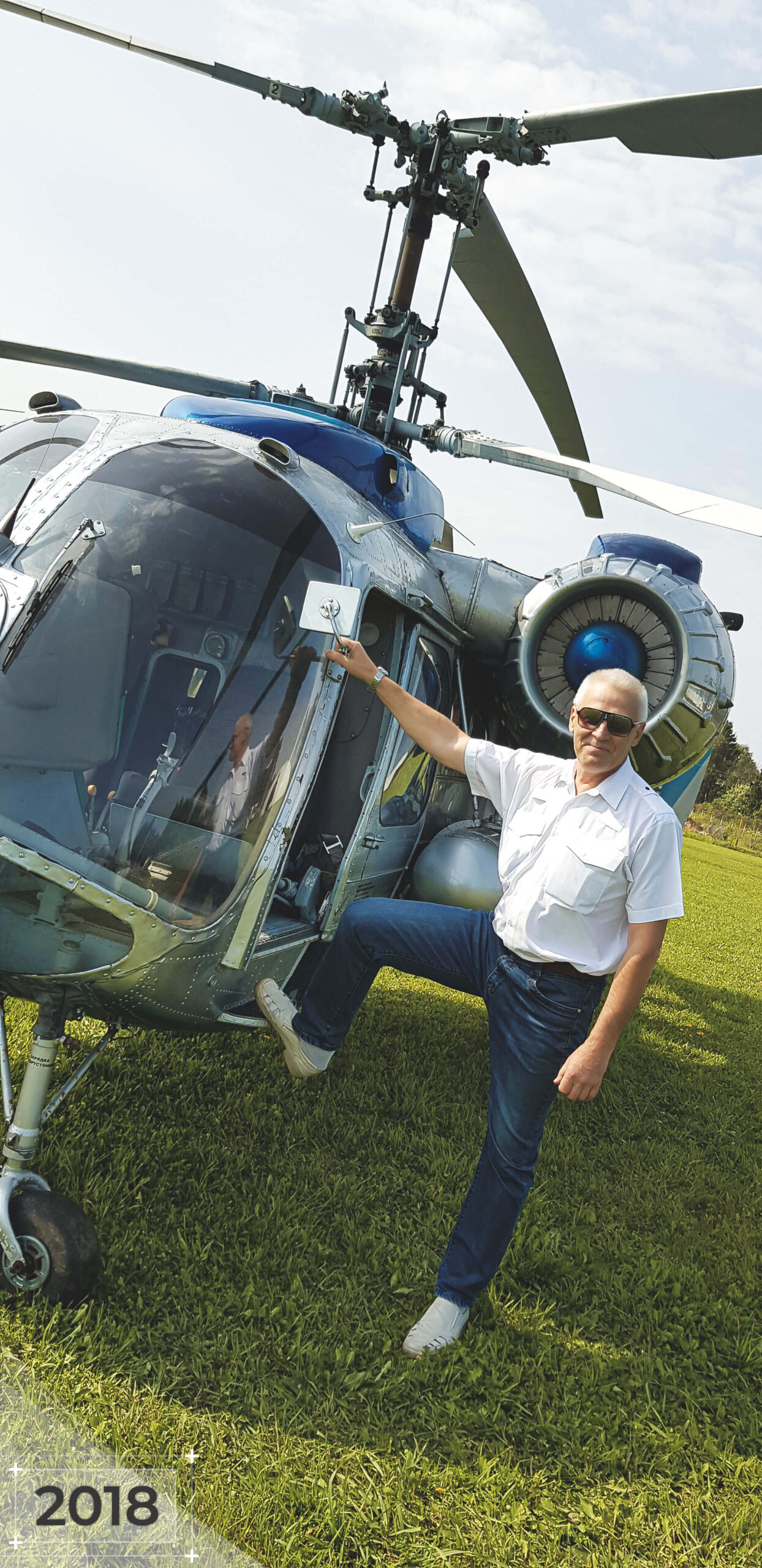
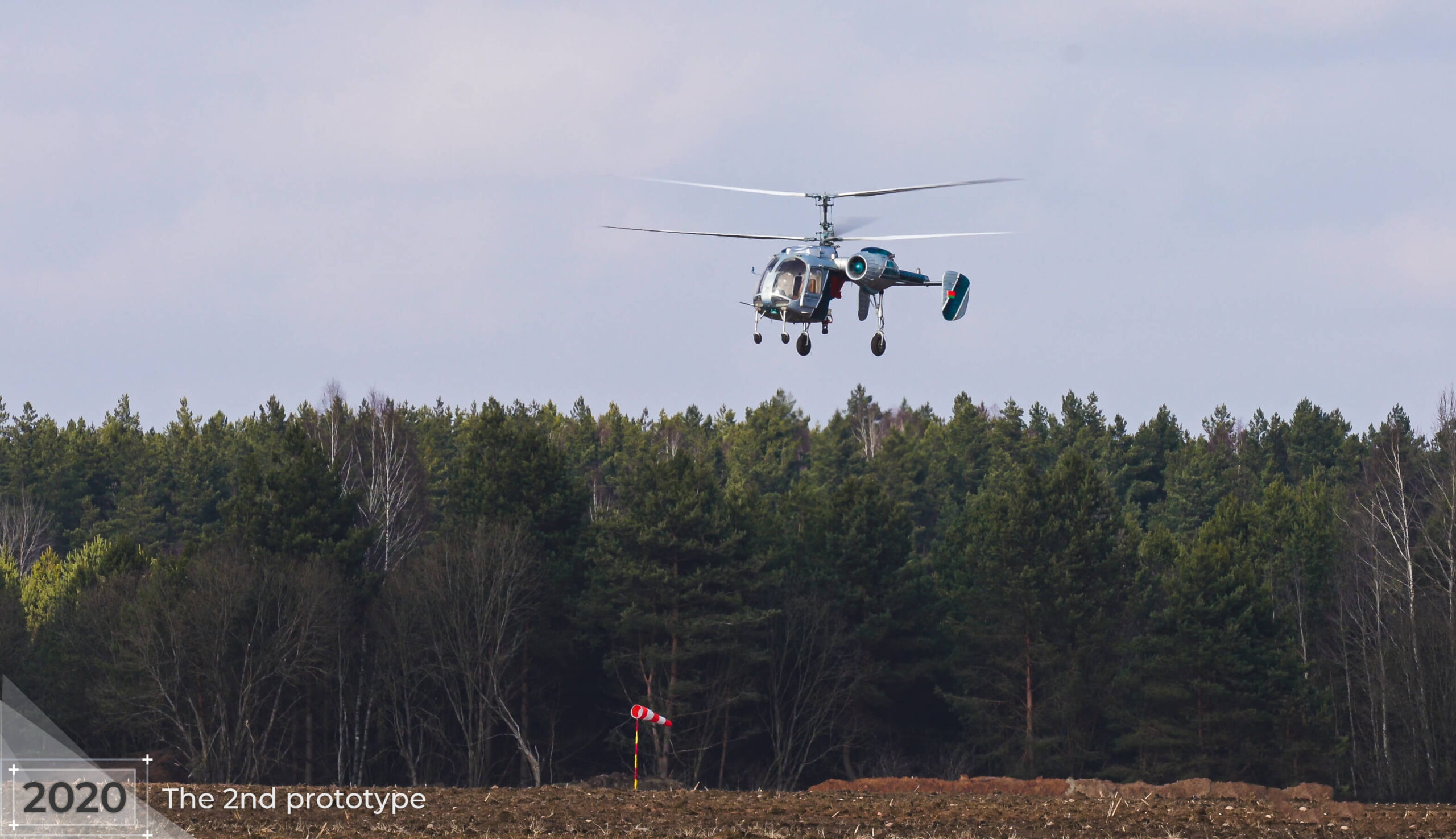
Sikorsky S-64 Skycrane recently has been converted into a drone. In terms of carrying capacity, it is the leader among dual-use unmanned helicopters. Almost at the same time, UVR completed the series of payload tests for the #1 among civil. The UVR Combo Drone, which was previously a Ka-26 manned helicopter, has already performed flights with heavy cargo.
At the beginning of 2021, UVR team performed tests at the company’s airfield near the village of Kukhtichi, Minsk region. Representatives of transport logistics operators were invited to the flights, as prime customers of an unmanned freight solution.
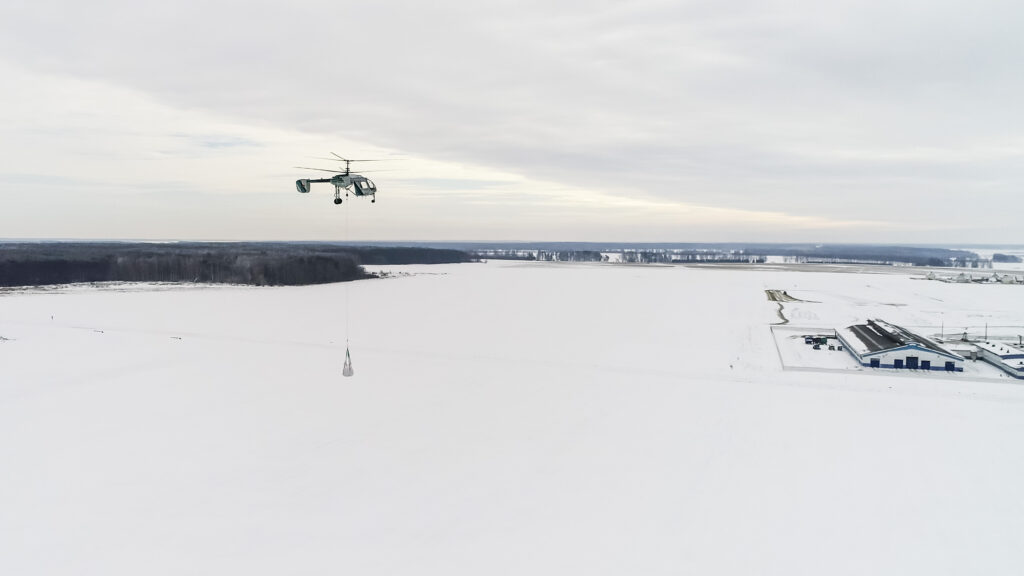
The Combo worked as a flying crane, carrying cargo on an external mount. Such functionality is required to transport an oversized cargo or provide delivery to locations where other transport is unlikely to be able to reach. A frequent task, for example, is the delivery of cell tower parts to the installation site and its erection on mountainous terrain.
UVR Combo Drone performed a flight in automatic mode. The total weight of the cargo, including fuel, was 750 kg, and the take-off weight was 2970 kg out of the maximum allowable 3250 kg.
Combo performed flights with loads of 200, 400 and 600 kg. The video is about how we have raised the bar and made it 750 kg.
The drone in hovering mode precisely and smoothly lowered the load to the ground. In a manned operation, hovering while holding a precise position is a difficult maneuver. A drone can do so with ease.
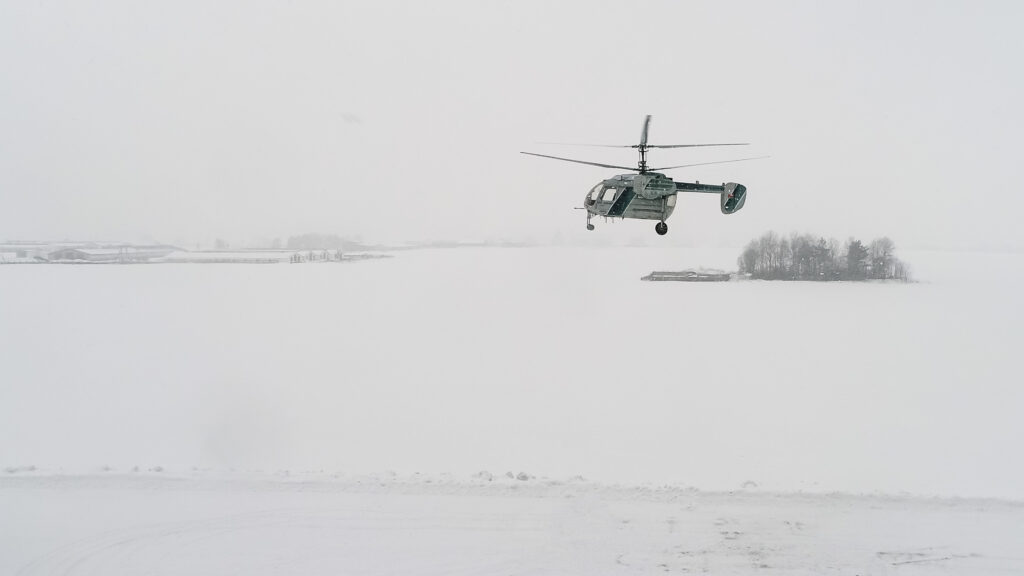
Another form of transportation was also tested, using the transport cabin. The drone carried 860 kg (including fuel) out of the maximum allowable 900 kg. The test took place in difficult weather conditions – frost, snowfall, and limited visibility. These circumstances did not prevent the drone from completing the flight task.
Weather conditions that are extreme for a manned helicopter, allow a drone to operate normally.
In addition to cargo transportation, Combo performed a flight with a landing at a site different from the takeoff one.
The purpose of the tests was to prove that Combo is not an experiment of enthusiasts, but a commercial product ready to perform real tasks. Earlier in 2020, the Combo drone automatically lifted and sprayed 300 liters of water simulating firefighting operations or aviation chemical works.
A fully automated flight with the payload for firefighting – 300 L of water.
UVR is now planning to operate the Combo in the real sector. In addition, the developer is obtaining documentation for the 2nd Combo with an increased payload of 1150 kg.
For us, the UVR Combo Drone is like a most-loved child who is just turning 3 years old today.
If we consider that children usually accumulate 100-500 photos showing how they grew up by their first birthday, everything is slightly different for our unmanned heavy-lifter.
It is hardly possible to show the development of autopilot, electronic components and display numerous hours of test flights frame-by-frame. What we can show is the result of our work – the most powerful civil drone in the world and, so far, the only one of its kind. By the end of the year, we plan to change this by expanding the Combo family with another converted helicopter.
Thank you to everyone involved in the project and the entire team, which has grown to almost 100 people in 3 years.
August 13, 2019 | Anton Motuzov
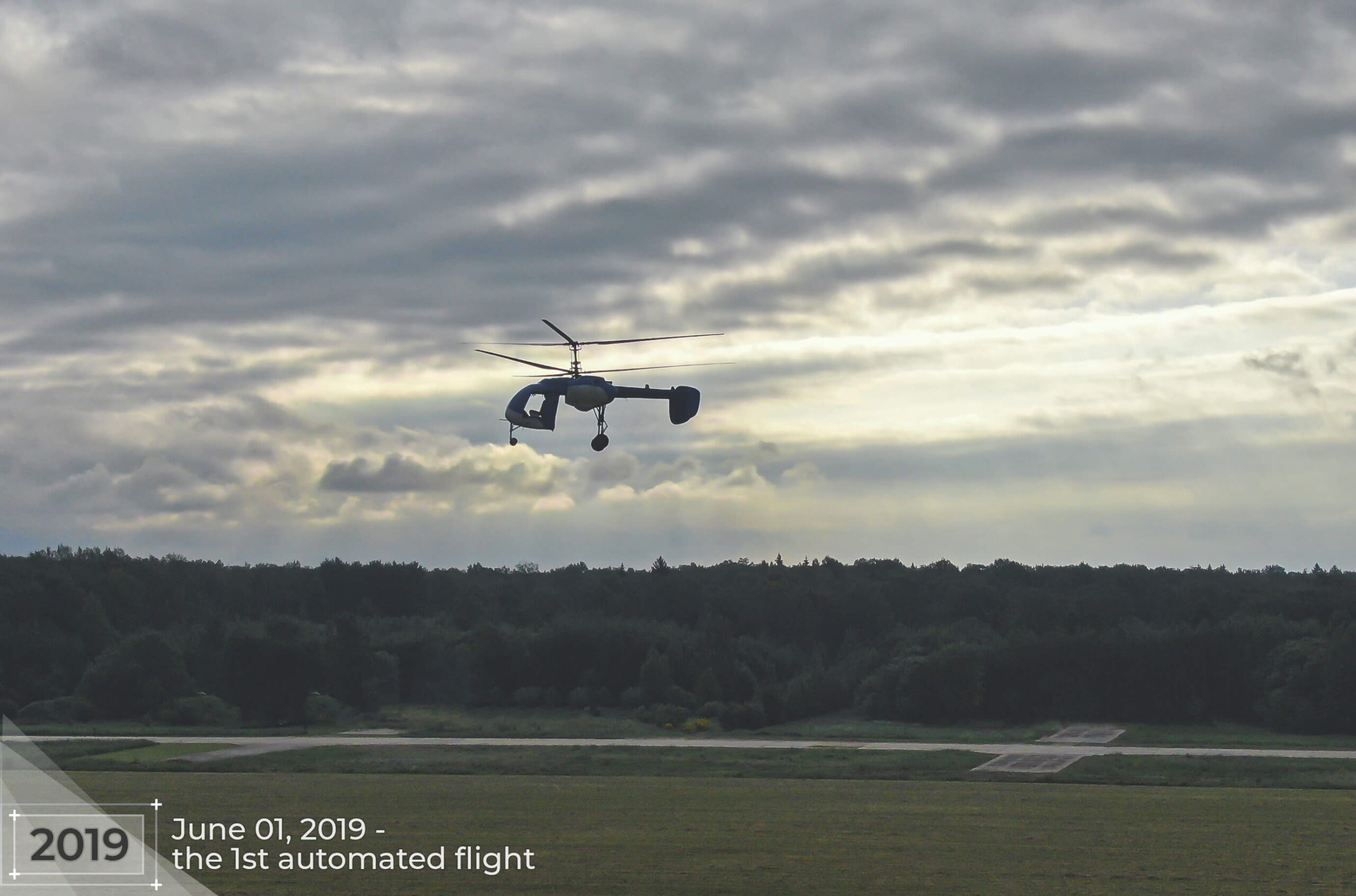
Workflow of testing fully autonomous drones / Summer 2019
While we are developing SAKAVIK and improving COMBO, our specialists in collaboration with aOrion are working on the autonomous flight algorithms.
July 20, 2019 | Anton Motuzov
UVR Sakavik
An unmanned aerial vehicle “COMBO” is not the only project UVR is working on. We are ready to announce the development of an ultra-light helicopter “Sakavik” now. Our goal is to create the most maneuverable aircraft with a payload up to 180 kg and a maximum speed up to 160 km/h. Follow the UVR news.
July 16, 2019 | Anton Motuzov
UVR Company – goals, objectives, ways to achieve
One of the high priorities of United Vehicle Robotics (UVR) has been carried out to set of works which create a service that provide freight using different types of unmanned vehicles (water, ground, air and space transport).
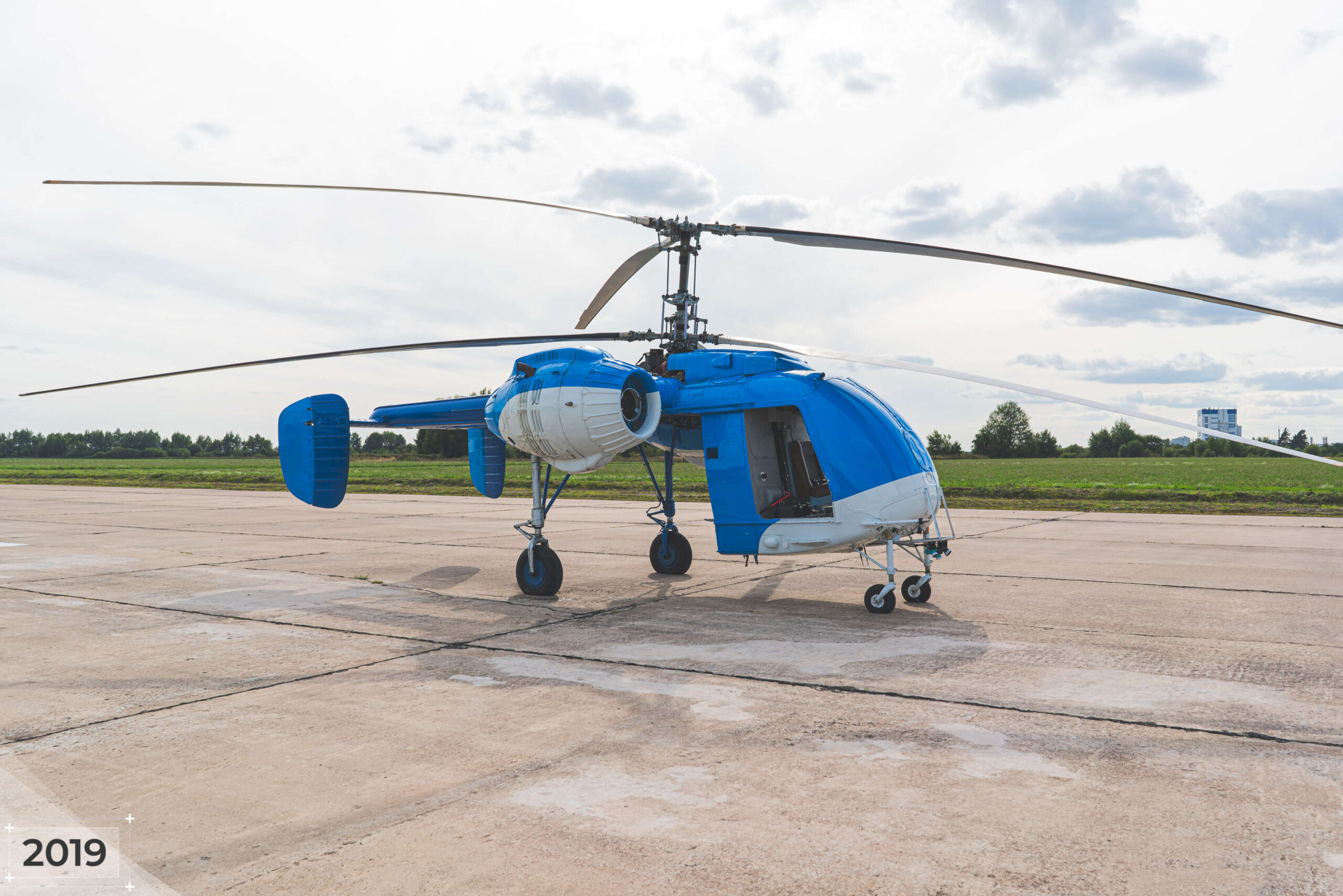
Towards the goal, work is being done and structured at key points. The completed by-product appears in the result. One of these branches has been the project of UAV which is based on the helicopter KA-26 – the test site for conducting the researches. As a result, we are able to refurbish any existing serial helicopter into UAV.
EVA | Unmanned Aerial Vehicle | Drone (Fully autonomous Test Flight)
There is a huge demand for such transformations on the market. It is the interim target for us, but only some companies in the world have been achieved the same. It took them significantly greater cost and time resources for this task. For more information, you can get acquainted with UVR Roadmap (you should contact with our manager for information).
The next stage was the development of our own aircraft system. Projecting is carried out to take into account the majority of worldwide safety standards. Needless to say, the implementing certification of the product will be taken into the consideration. The control system is based on the multiply reserved system: 12 autopilots are installed on the vehicles and they can decide the flight’s logic on the basement of relevant mathematical computing by multiagent’s voting. Moreover, the off-site system which has been developed by the second group of developers or the third parties can be used with our main system on the board. It is allowed to minimize the influence of the human factor in the way of errors of projecting and code writing.
There is a so-called high level of the control system which uses the elements of AI and machine learning also exists in common compound. More than 1000 possible variants of trajectory of movement are calculated every second and the choice of the optimal trajectory has to be done knowing the performance of transport, environment and possible mechanical failure. There are a lot of sensors make it possible to obtain graphical information with external sources, to identify obstacles and implement their classification. The construction of a personal map has to be done on the basis of existing information which is distributed among other system members.
UVR develops special service application for system supporting in a current state. It is planned to implement unidentified databases from the majority of the UAVs with our control system and to undertake in-depth on the basis of existing information, to improve systems of self-study, to carry out regular updating of software in several stages, etc.
Platform
The development of full autonomous platform also integrates in the plans of United Vehicle Robotics Company. It will allow to lower the costs and to simplify maintenance repeatedly for the end-user in the way of cost reduction to recruitment of qualified pilots and furnishing of the pilot’s cockpit in the aircraft. This system can lead to revolution in the aircraft system. The greatest exclusion of the human factor and the improvement of the aircraft’s design underpins. From the point of view of safety our UAVs have the protection against electromagnetic pulses, interferences and powerful electromagnetic fields. The developing power units will carry out long-term flights without any consequences. In case of safety incidents and denying of two main engines our extra power unit allows to do the horizontal flight during 5-8 minutes. This flight will depend on incumbency and make the emergency landing if we take into account maximum safety of the objects which are located inside and outside of the aircraft. Our development is fully integrated with the latest amendments according to the rules of Federal Aviation Administration and EASA. It is disproportionately higher than theirs. We are working to take this matter to the next level.
It is planned to ramp up the trafficking of production to 10000 of UAVs with a heavy lift capacity and we will ensure the development of worldwide service of transportation and convoying to 2030.
Order Now
Here you can submit an order for your cargo unmanned aircraft. In addition, we are open to collaborations and will be glad to receive a proposal or answer your questions.